Launch offer — valid today only

📄 Digital book in PDF · read it on your phone or print it

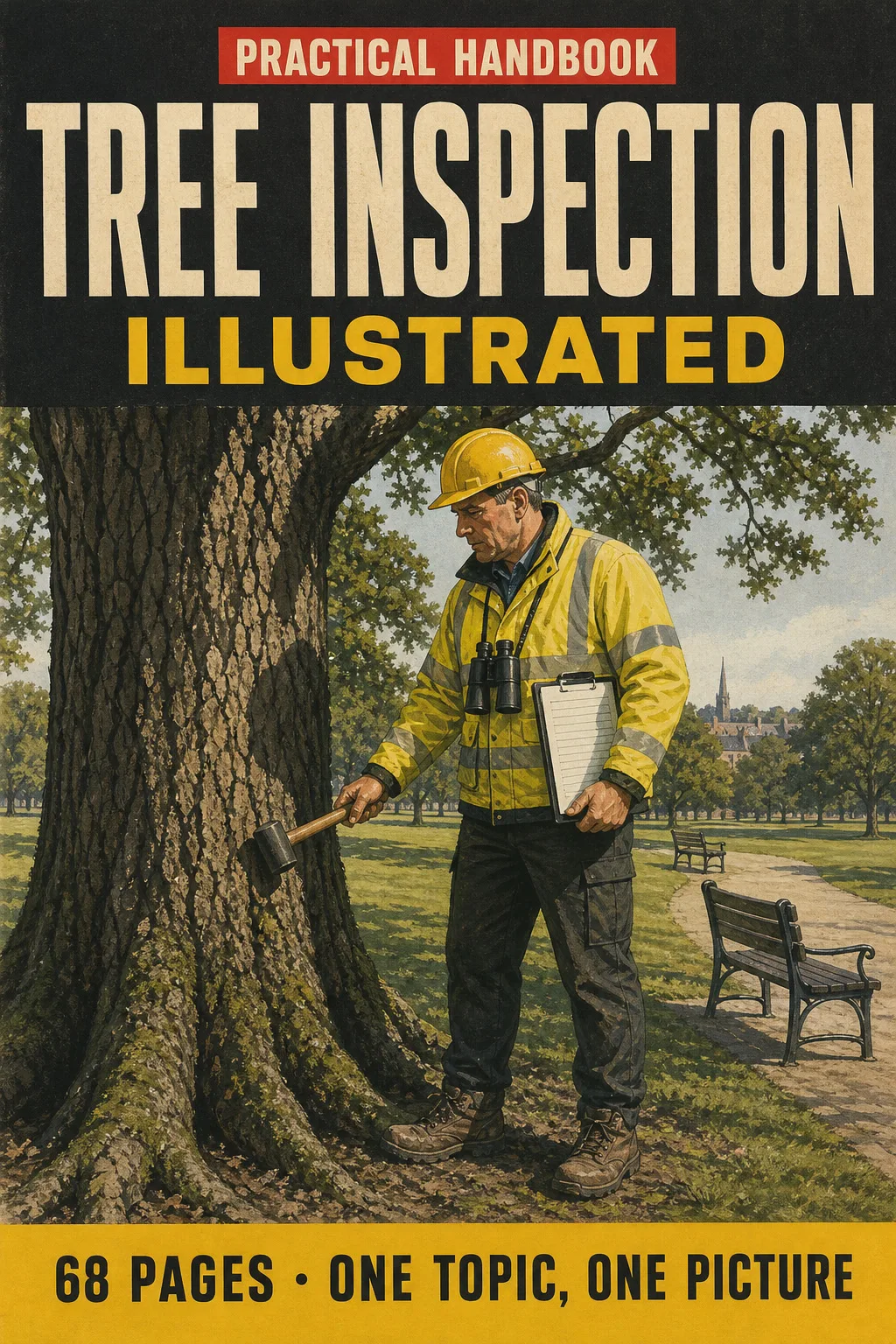
Tree Inspection, Drawn: Read Every Tree from Base to Crown Every Tree in the Same Order

Duty of care, CODIT, reaction wood, root protection areas, included bark, decay fungi, deadwood and risk rating. Every topic has its own page: the drawing first, then what you need to remember. 68 illustrated pages.

START STUDYING THIS WAY

🔒 Secure checkout · PDF by email · 30-day guarantee

Every topic, its own pageEach defect, fungus and rule drawn, with the explanation beside it
68 illustrated pages9 parts, from duty of care to the five-tree site worked example
Up-to-date sourcesNTSG and HSE guidance, BS 3998 and BS 5837
PDF by emailFormat

Look Inside the Book

Every page has one large drawing and a box with the measurements, rules and steps you need to know:

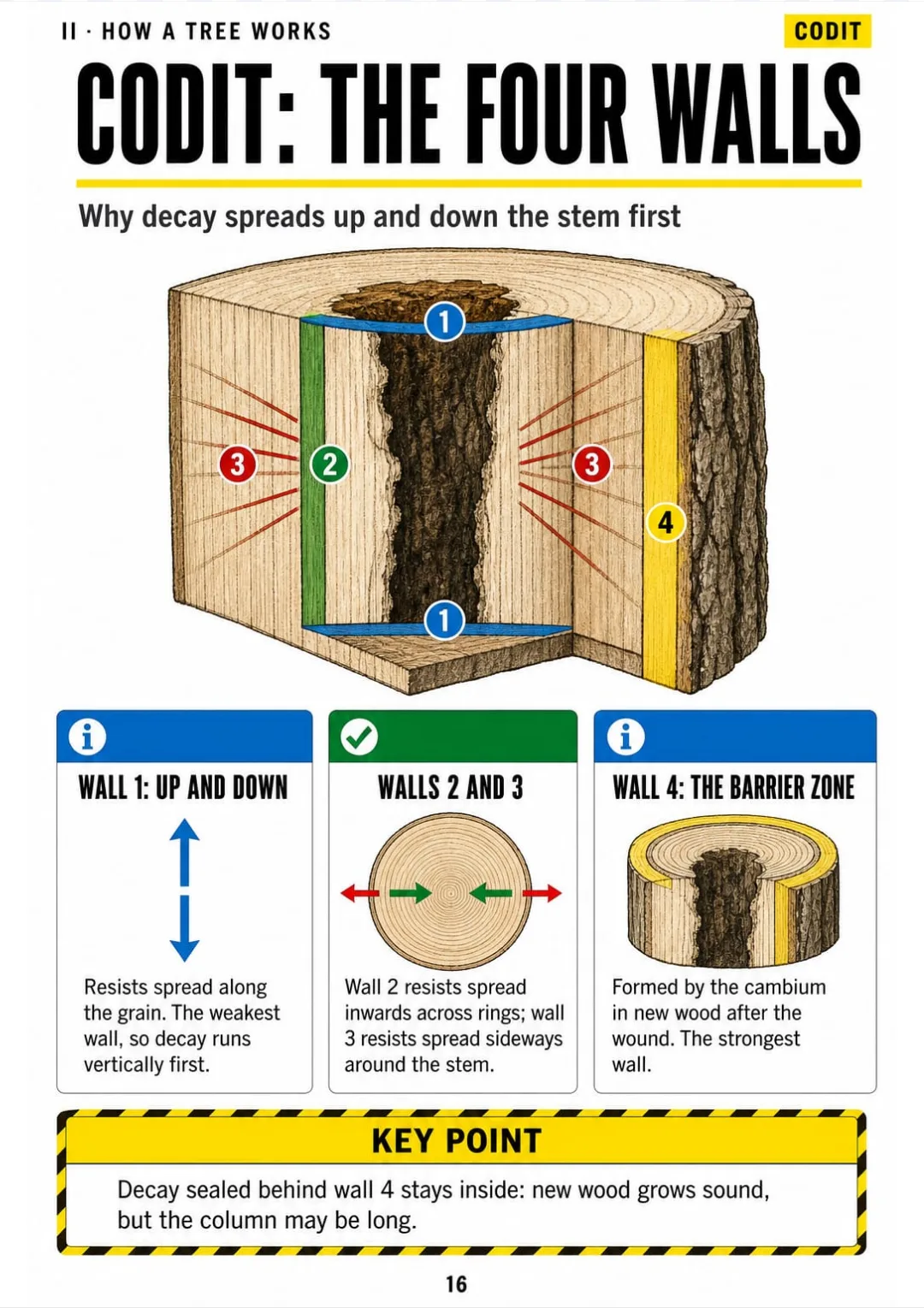
CODIT: wall 1 is weakest, wall 4 strongest, so decay spreads vertically first.
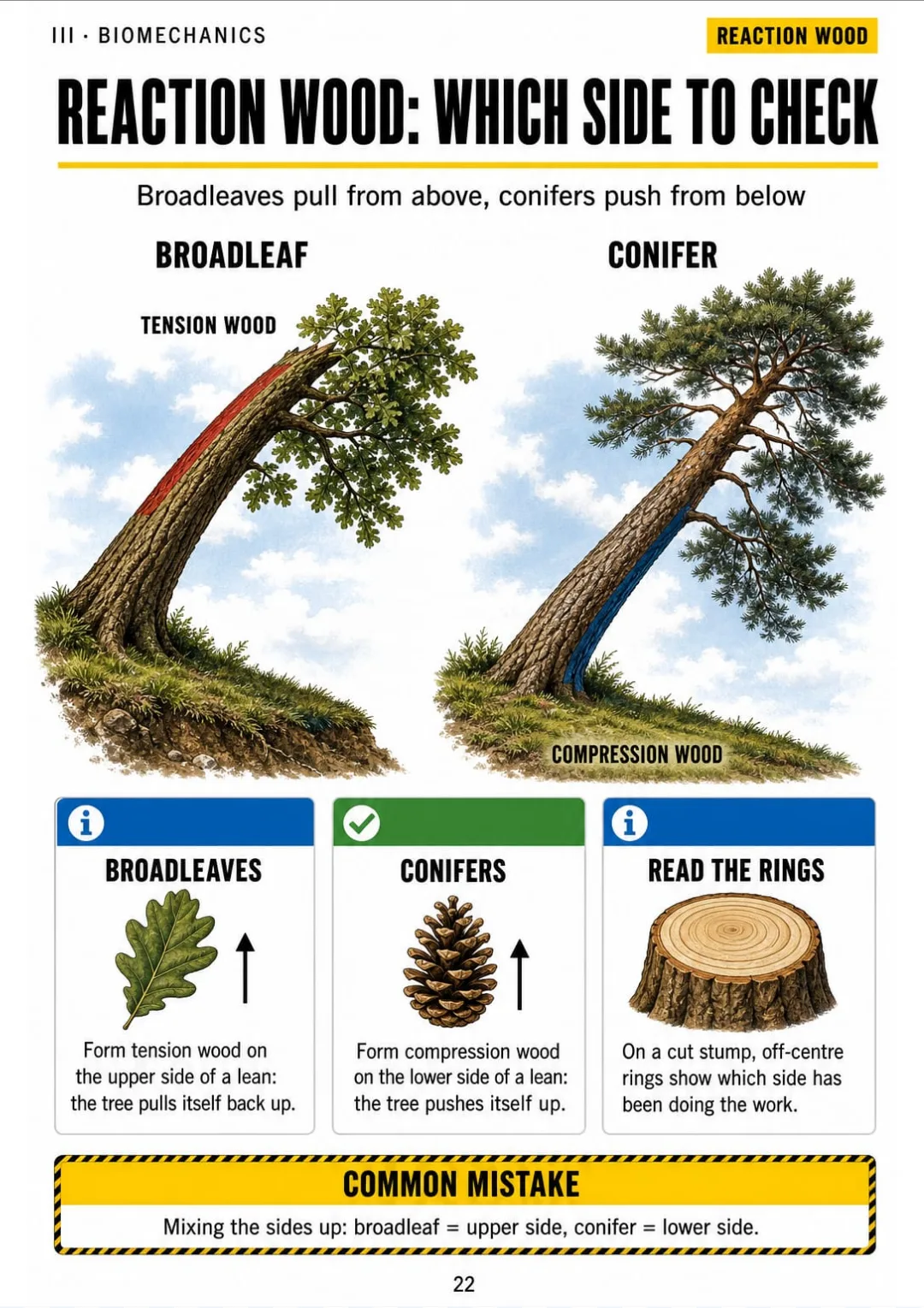
Tension wood on top in broadleaves, compression wood below in conifers.
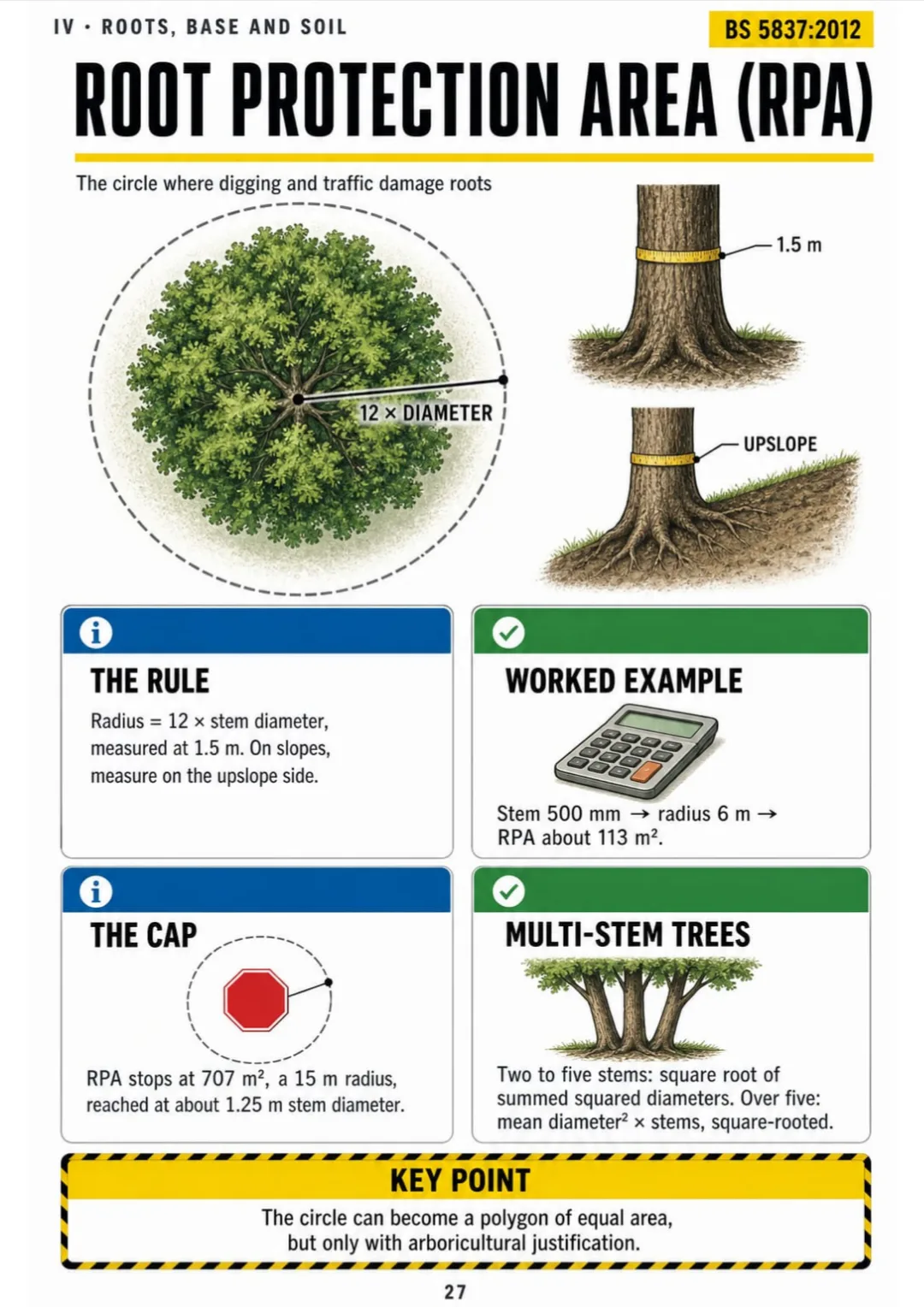
RPA radius = 12 × stem diameter at 1.5 m, capped at 707 m² (15 m radius)
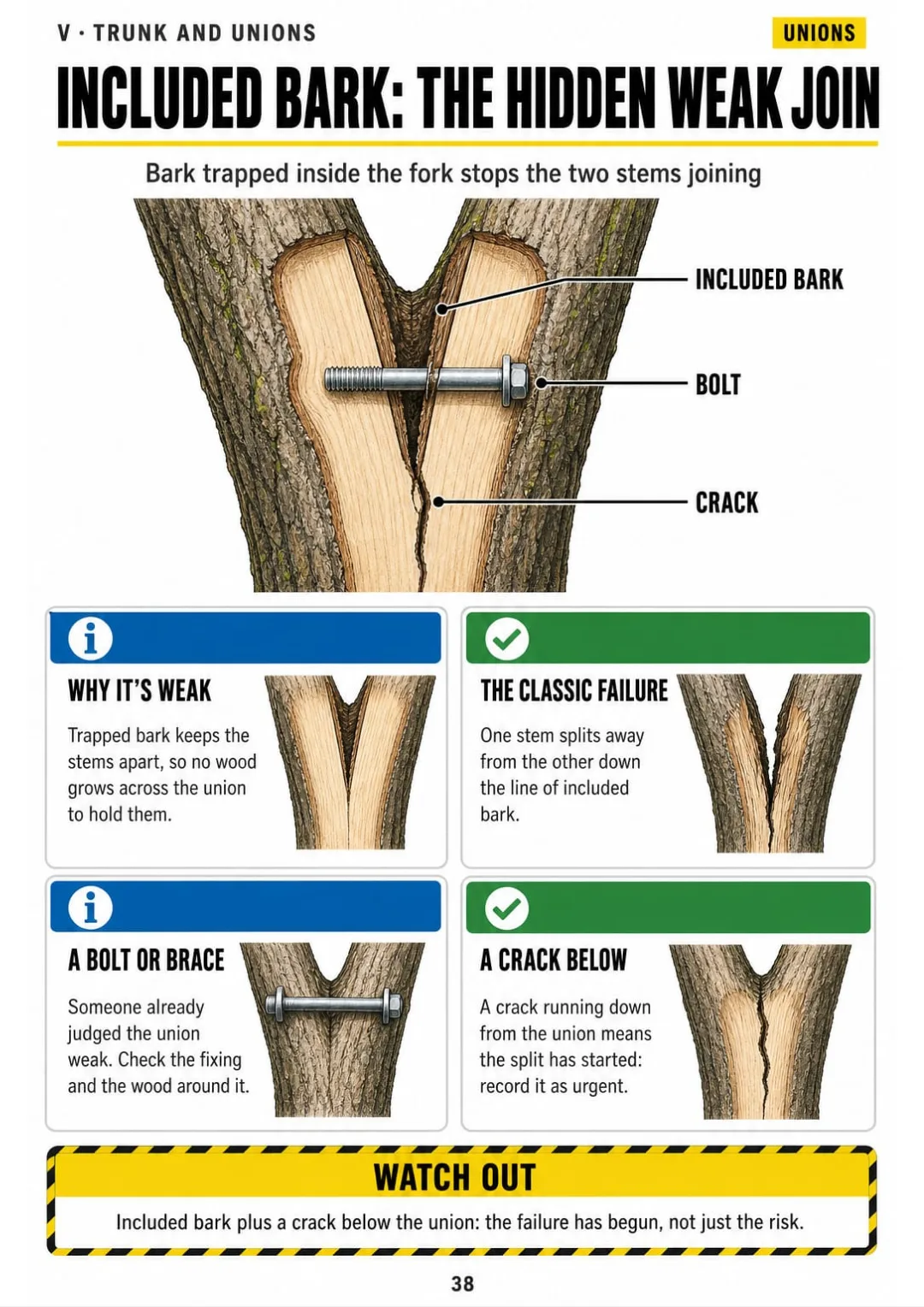
Included bark, bracing bolt, crack below: why a twin-stemmed tree splits
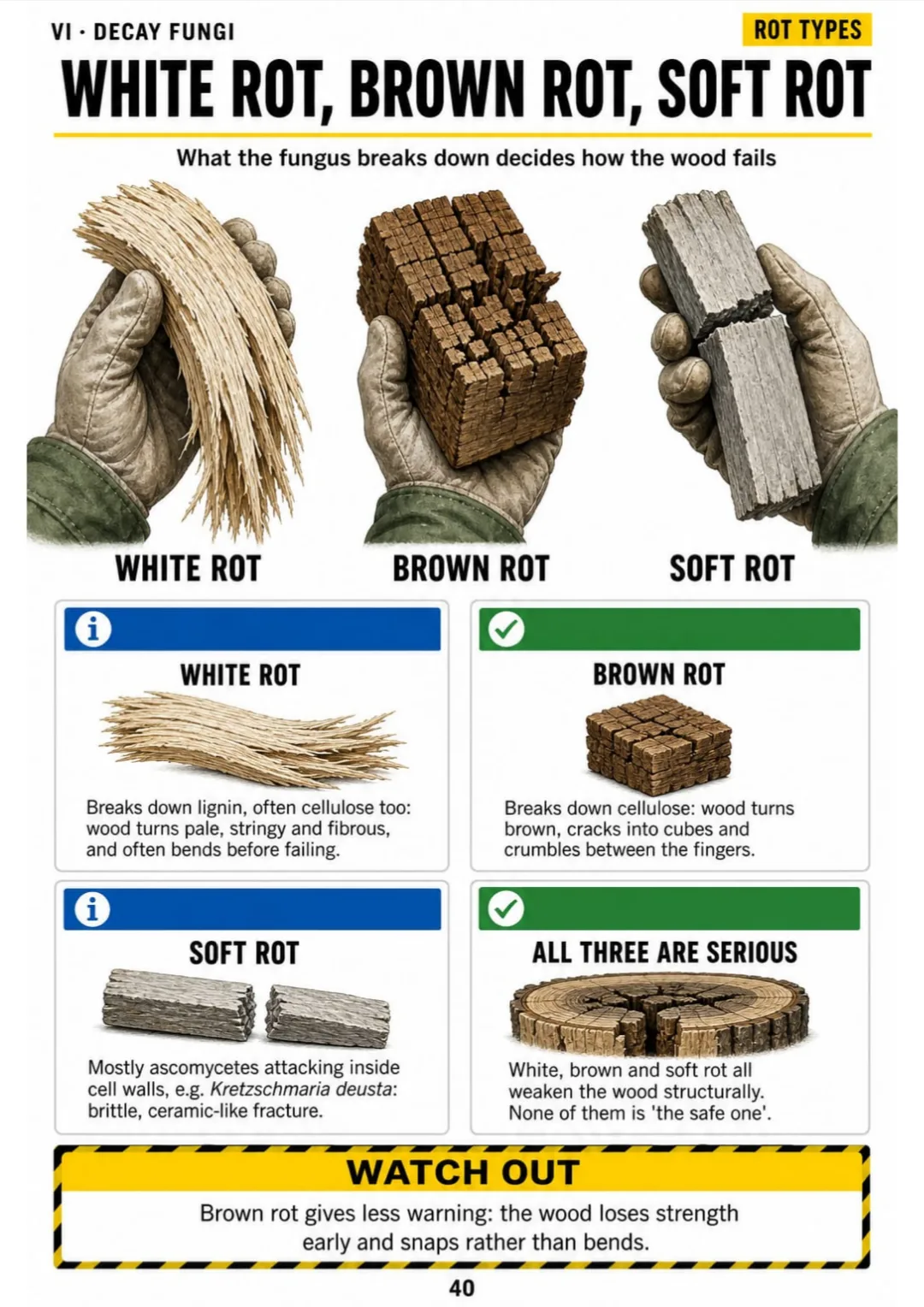
White rot: stringy and bends · Brown rot: cubes and snaps · Soft rot: brittle break
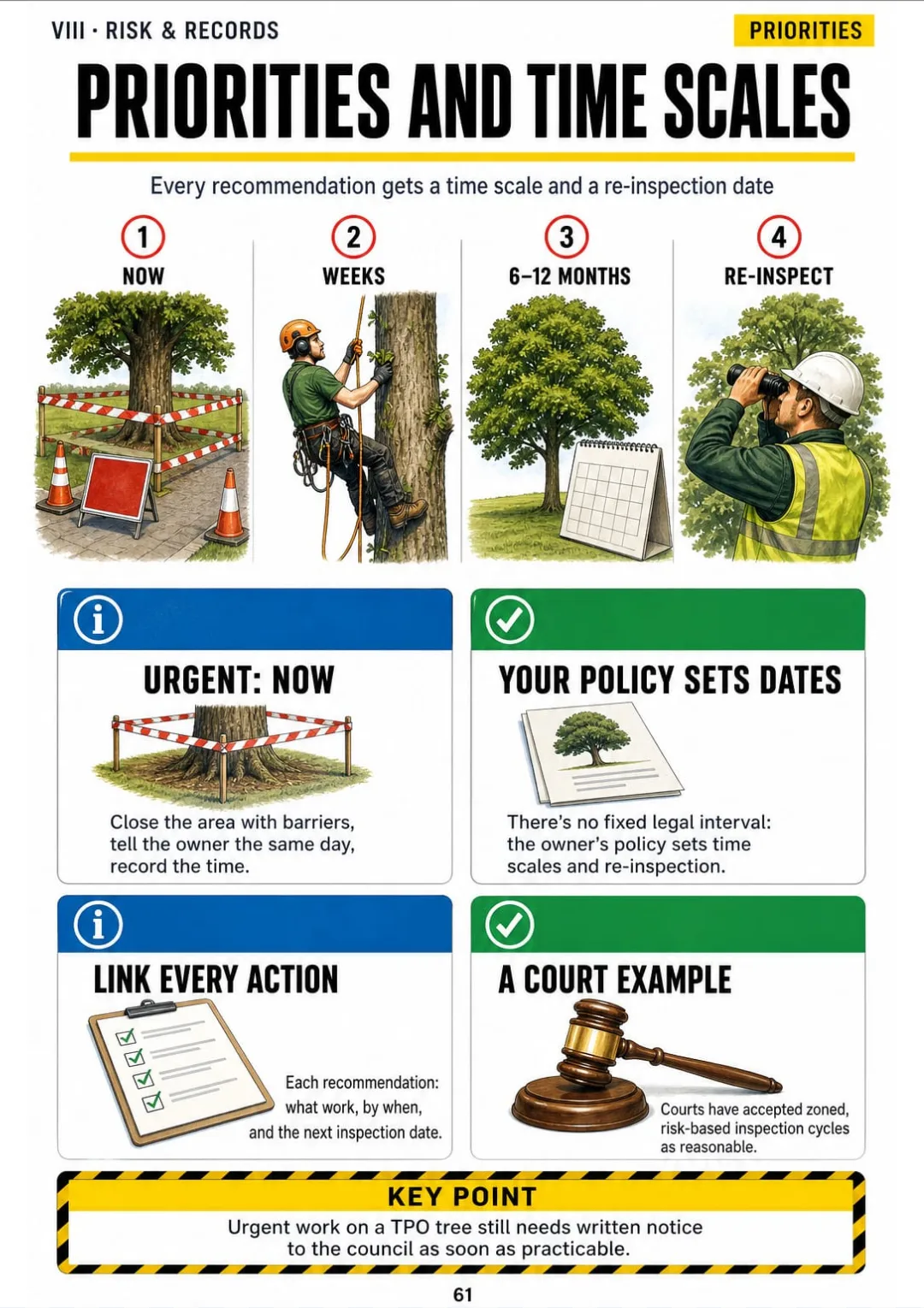
Four time scales, each recommendation tied to a date and a next inspection.
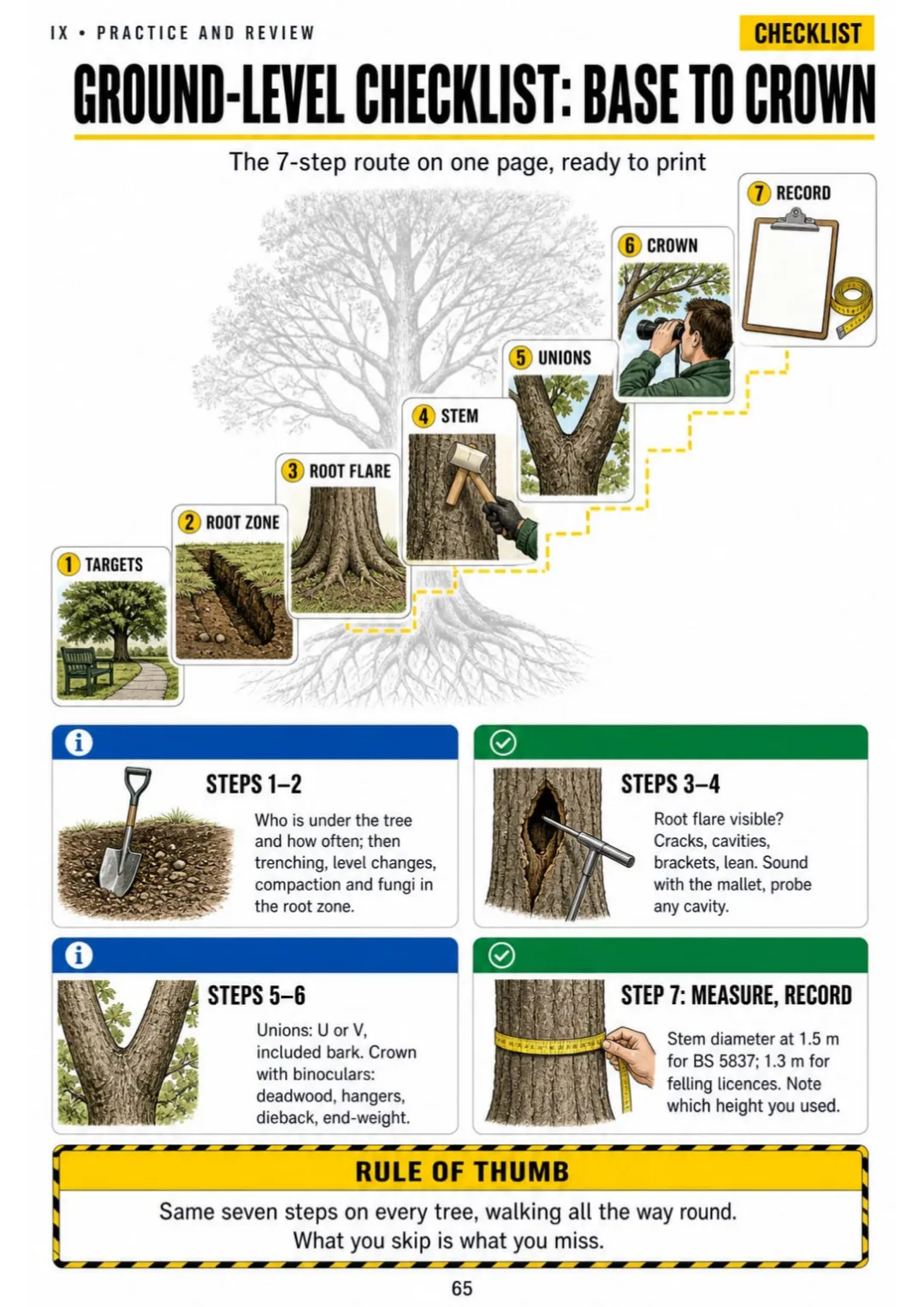
Targets, root zone, flare, stem, unions, crown, record: one printable route for every tree.
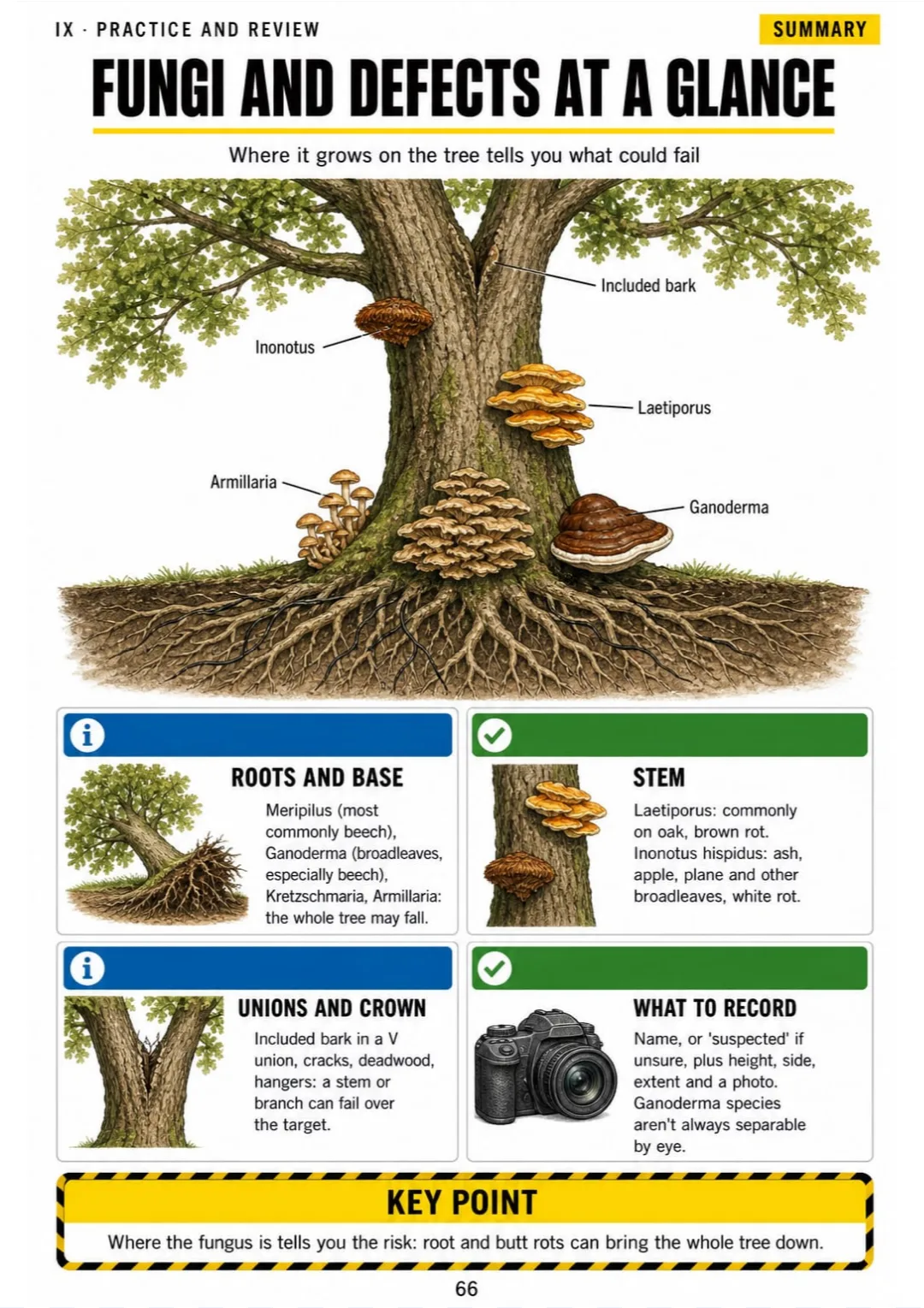
Root and butt rots at the base: the whole tree may fall. Stem rots: record height and side.

Swipe to see more →

These are real pages from the book. The table of contents is the full one: 9 parts and 64 topics.

The Problem Isn't You. It's How It Was Explained to You.

You're standing next to a mature oak. A contractor wants to dig a trench for a new cable run and asks you how close he can go.

You've read the root protection area section in the course notes. It's paragraphs of stem diameters, multipliers and area caps, and on site none of it comes back in the right order.

RPA radius = 12 × stem diameter at 1.5 m, capped at 707 m² (15 m radius)

In the book, the root protection area is one page: the stem measured at 1.5 m, the radius drawn as 12 times that diameter, and the circle marked on the ground, capped at a 15 m radius.

The same goes for CODIT, reaction wood, included bark and white, brown and soft rot: each one has its own page.

You measure the stem, work out the radius, mark the zone and give the contractor an answer without going back to the manual.

COMPARE FOR YOURSELF

The Same Topic, Two Ways to Study It

THIS
  • The manual: line after line
  • Reaction wood explained only in words
  • You reach the assessment still unsure
Reaction wood is formed by trees in response to gravitational or mechanical stimuli, with the purpose of restoring or maintaining the orientation of stems and branches. In angiosperms (broadleaved species), reaction wood is produced on the upper side of leaning stems and branches and is termed tension wood, characterised by gelatinous fibres. In gymnosperms (conifers), it develops on the lower side and is termed compression wood, with a higher lignin content. Its presence, and the associated eccentric growth, should therefore be taken into account when assessing lean.
FOR THIS
  • Reaction wood in one drawing
  • Which side to check, in a box
  • You see it and you get it
Tension wood on top in broadleaves, compression wood below in conifers.
CONTENTS

Take a Look at the 9 Parts and 64 Topics

The inspector's job, how a tree works, biomechanics, roots and soil, trunk and unions, decay fungi, the crown, risk and recording, and practice and review: 68 pages, all illustrated

IThe inspector's job · pp. 5-11
  1. Duty of care: who you are protecting
  2. Reasonable, not zero risk
  3. Zones of use
  4. Survey types: walk-over, basic, detailed
  5. Inspection frequency
  6. The kit in the van
  7. The inspection route: always the same order
IIHow a tree works · pp. 12-19
  1. The tree in cross-section
  2. Sapwood vs heartwood
  3. Leaves, energy and storage
  4. Annual rings and growth increments
  5. Compartmentalisation of decay (CODIT)
  6. Wounds and woundwood
  7. Vitality vs structure
  8. Life stages and ageing trees
IIIBiomechanics · pp. 20-25
  1. Loads on a tree
  2. Axiom of uniform stress
  3. Reaction wood
  4. Response growth: ribs, bulges, buckling
  5. Hollows and residual wall
  6. Slenderness and exposure
IVRoots, base and soil · pp. 26-32
  1. Where the roots really are
  2. Root protection area
  3. Reading the root flare
  4. Compaction, trenching and changes in level
  5. Root plate movement
  6. Girdling and stem-girdling roots
  7. Waterlogging and drought
VTrunk and unions · pp. 33-39
  1. Sounding with the mallet
  2. Cavities and the probe
  3. Cracks and seams
  4. Lean
  5. Codominant stems: U and V unions
  6. Included bark
  7. Cankers, bleeding and dead bark
VIDecay fungi · pp. 40-49
  1. White rot, brown rot, soft rot
  2. Where the fungus is tells you the risk
  3. Meripilus giganteus
  4. Kretzschmaria deusta
  5. Ganoderma species
  6. Armillaria (honey fungus)
  7. Laetiporus sulphureus
  8. Inonotus hispidus and Polyporus squamosus
  9. Brackets gone, decay still there
  10. Diseases you must report or recognise
VIIThe crown · pp. 50-54
  1. Reading the crown from the ground
  2. Deadwood and hangers
  3. Weak branch attachments and epicormics
  4. Over-extended limbs and end-weight
  5. Wildlife and the crown
VIIIRisk, recording and recommendations · pp. 55-62
  1. Hazard is not risk
  2. The three questions of risk
  3. Tolerable and acceptable risk
  4. Recording a tree
  5. Writing observations that stand up
  6. Tree work terms that match BS 3998
  7. Priorities and time scales
  8. Permissions before work
IXPractice and review · pp. 63-68
  1. Worked example: a five-tree site
  2. Worked example: a tree by the road
  3. Ground-level checklist: base to crown
  4. Fungi and defects at a glance
  5. The most frequent inspection mistakes
  6. Before the assessment

One Page, One Topic, All Clear

Think of it this way:

You're on a school site and there's a bracket at the base of a beech, right beside the path where the children queue. You need to know what that fungus means for the whole tree.

You open the page on fungi and defects at a glance and see it drawn: root and butt rots at the base, where the whole tree may fall, and stem rots, where you record height and side.

White rot: stringy and bends · Brown rot: cubes and snaps · Soft rot: brittle break

The same with CODIT, included bark, reaction wood, the root protection area and priorities and time scales: each one on its own page.

Tree Inspection Illustrated is 9 parts and 64 topics, all drawn, with two worked site examples, a ground-level checklist and a review section at the end.

What you see drawn, you don't have to memorize.

What's Inside Tree Inspection Illustrated:

Ipp. 5-11

The inspector's job

Duty of care, reasonable rather than zero risk, zones of use, survey types, inspection frequency, the kit in the van and the route you follow every time.

IIpp. 12-19

How a tree works

The tree in cross-section, sapwood and heartwood, energy and storage, growth rings, CODIT, wounds and woundwood, vitality vs structure and ageing trees.

IIIpp. 20-25

Biomechanics

Loads on a tree, the axiom of uniform stress, reaction wood, ribs, bulges and buckling, hollows and residual wall, slenderness and exposure.

IVpp. 26-32

Roots, base and soil

Where the roots really are, the root protection area, the root flare, compaction and trenching, root plate movement, girdling roots, waterlogging and drought.

Vpp. 33-39

Trunk and unions

Sounding with the mallet, cavities and the probe, cracks and seams, lean, U and V unions, included bark, cankers, bleeding and dead bark.

VIpp. 40-49

Decay fungi

White, brown and soft rot, why the fungus's position tells you the risk, the main UK decay fungi one by one, and the diseases to report or recognise.

VIIpp. 50-54

The crown

Reading the crown from the ground, deadwood and hangers, weak attachments and epicormics, over-extended limbs and wildlife.

VIIIpp. 55-62

Risk, recording and recommendations

Hazard vs risk, the three questions of risk, tolerable risk, recording a tree, observations that stand up, tree work terms, time scales and permissions.

IXpp. 63-68

Practice and review

Two worked site examples, the base-to-crown checklist, fungi and defects at a glance, the most frequent mistakes and the run-up to the assessment.

At the end of the book: Two worked site examples, a printable base-to-crown checklist and fungi and defects at a glance.
Plus: 2 Free Books

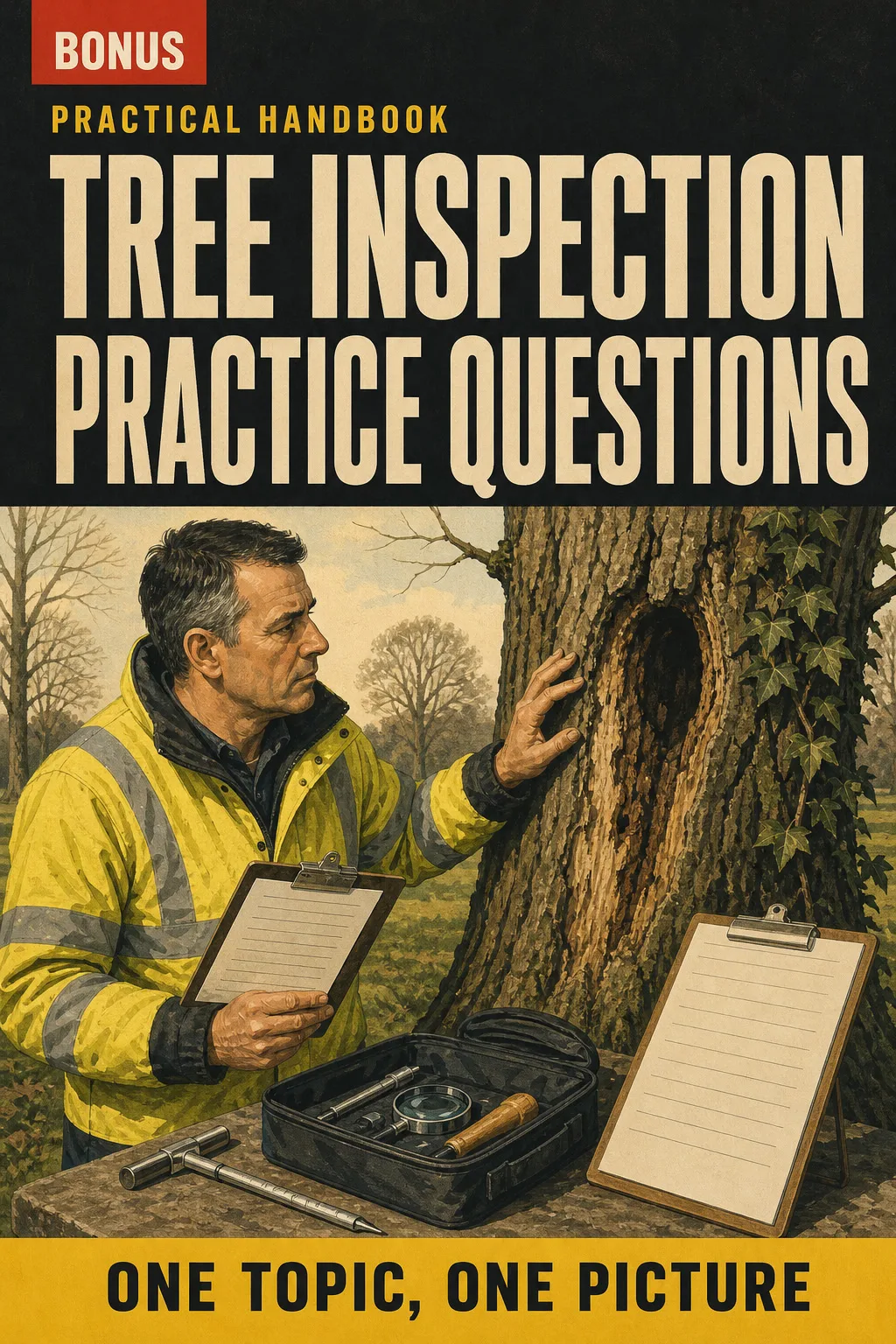
Tree Inspection Practice Questions

BONUS 1: «Tree Inspection Practice Questions»

Value on its own: US$ 17.90

Exam-style questions with worked answers on fungi, defects, duty of care and risk, so you can test yourself before the written and practical assessment.

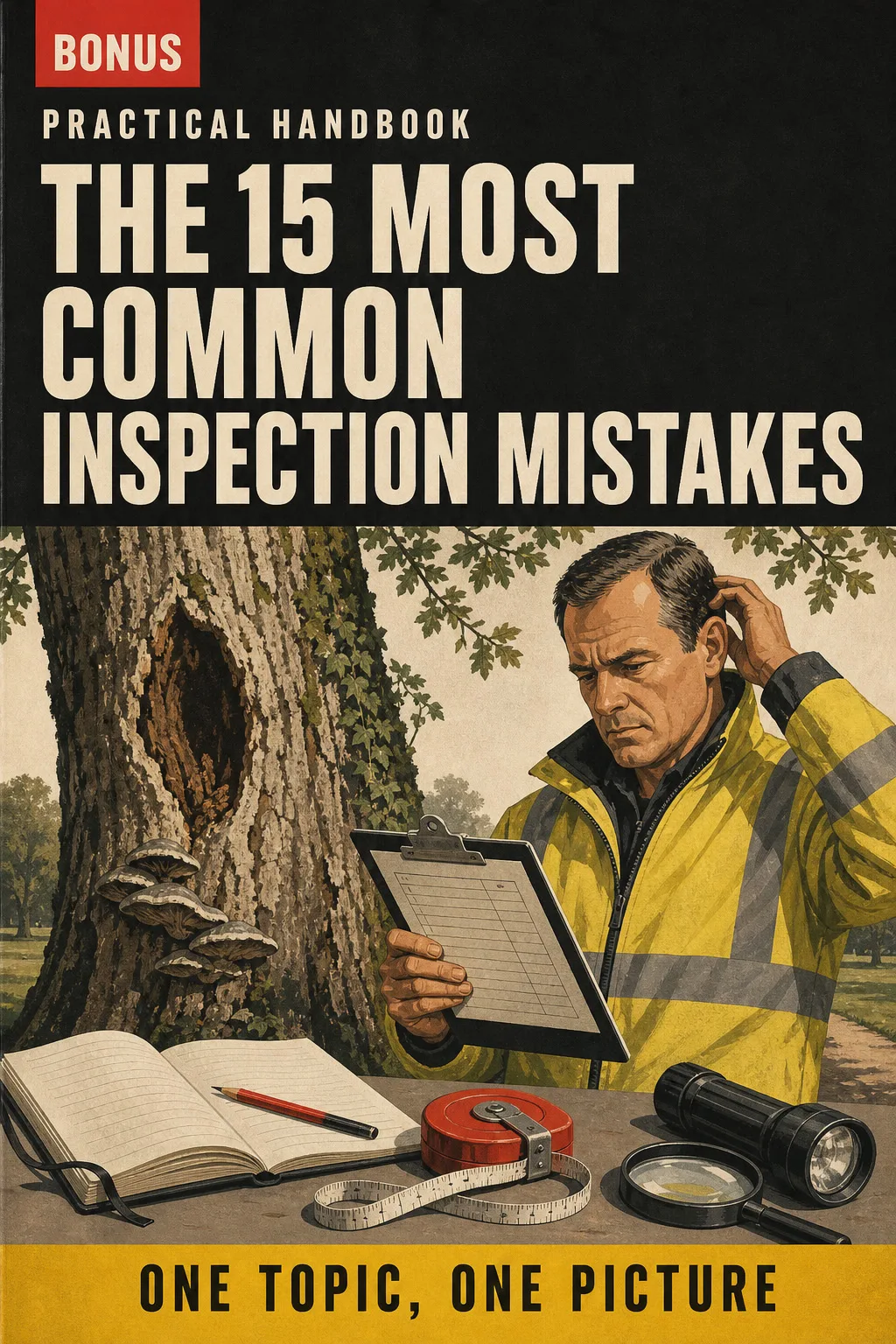
The 15 Most Common Inspection Mistakes

BONUS 2: «The 15 Most Common Inspection Mistakes»

Value on its own: US$ 14.90

The errors inspectors make most often, each one drawn before and after, so you spot them in your own notes before they end up on a report.

Tree Inspection Illustrated with 2 Free Books

  • Tree Inspection Illustrated: 68 illustrated pagesUS$ 63
  • BONUS 1: Tree Inspection Practice QuestionsUS$ 17.90
  • BONUS 2: The 15 Most Common Inspection MistakesUS$ 14.90
  • High-resolution PDF to printIncluded
Total value US$ 95.80
YOUR PRICE:
US$ 27
You save US$ 68.80
YES, I WANT TREE INSPECTION ILLUSTRATED FOR US$ 27

📄 This is a digital PDF book sent to your email: nothing is printed or shipped.

Secure purchaseEncrypted payment30-day guarantee

PDF by email: We email you Tree Inspection Illustrated as a PDF, together with the two free books. It's a single payment: no installments, no extra charges.

Who This Book Is For

You're on the inspection course

You're on the inspection course

Every topic from tree biology to risk on its own page, in the same order you inspect a tree, so each evening's study builds on the last.

Your assessment is close

Your assessment is close

The checklist, the fungi at a glance and the practice questions let you go over the whole route in the last week, without opening the course file.

You already sign inspections

You already sign inspections

Print the pages you use most and keep them in the van: root protection area, fungi, time scales. Ready when someone asks if a tree is safe.

Everything You Get Today

US$ 95.80US$ 27
YES, I WANT TREE INSPECTION ILLUSTRATED FOR US$ 27

📄 This is a digital PDF book sent to your email: nothing is printed or shipped.

30DAYS
GUARANTEE

30-Day Guarantee

Try Tree Inspection Illustrated for 30 days, bonus books included.

We refund everything if the file won't open, if the book isn't what you see here, if you were charged twice or if the email doesn't arrive. Just email us.

You pay once. No subscriptions.

Frequently Asked Questions

Is it for me if I've worked with trees for years and now have to sign inspections?

Yes. It doesn't teach you to use a saw, and nothing is dumbed down. Your fungi guide shows you photos and your course file explains in paragraphs. This book puts both into one inspection route, from roots to crown, with each fungus, defect and risk rule drawn on its own page. That includes where the fungus sits and what it means for the tree, the root protection area worked out, and time scales tied to a date.

Where does the content come from?

It's checked against current UK guidance: the National Tree Safety Group's guidance, HSE guidance on falling trees, BS 3998, BS 5837 and the Occupiers' Liability Acts. They're referenced descriptively; no text or tables are reproduced.

Is it official material?

No. It's an independent study guide, not affiliated with or endorsed by any awarding body, association or authority.

Does it replace the course or the training?

No, and it doesn't give you a certificate. The qualification comes only from your course provider and its written and field assessment. This book is for revising alongside a professional tree inspection course, such as the Lantra course, and the field practice that comes with it.

Are the practice questions the ones from the assessment?

No. They're written for this book, in assessment style, so you can test yourself. They aren't official questions.

When and how do I receive it?

As a PDF by email, to the address you enter when you pay. The 2 bonus books come the same way.

Do I have to pay every month?

No. It's a one-off payment.

Can I have it on paper?

Not as a posted book: you get a PDF by email. It's designed to print at home or at a print shop, either the whole book or just the pages you want in the van.

How does the refund work?

You have 30 days. We refund everything if the file won't open, if the book isn't what you see on this page, if you were charged twice or if the email doesn't arrive: just email us.

Before You Close This Page

No more rereading notes that don't stick.

A bracket at the base, a crack below the union: you see it drawn and that's it.

You go into the assessment knowing where everything is.

Drawings make studying faster.

The book is right below.

One-time payment: US$ 27 · Guarantee: 30 days · PDF by email

YES, I WANT TREE INSPECTION ILLUSTRATED FOR US$ 27

📄 This is a digital PDF book sent to your email: nothing is printed or shipped.